Your best engineers should be building features, not investigating tickets.
Support engineers spend 70% of every ticket on investigation. BuildWright does the investigation. Your team does the fixing.
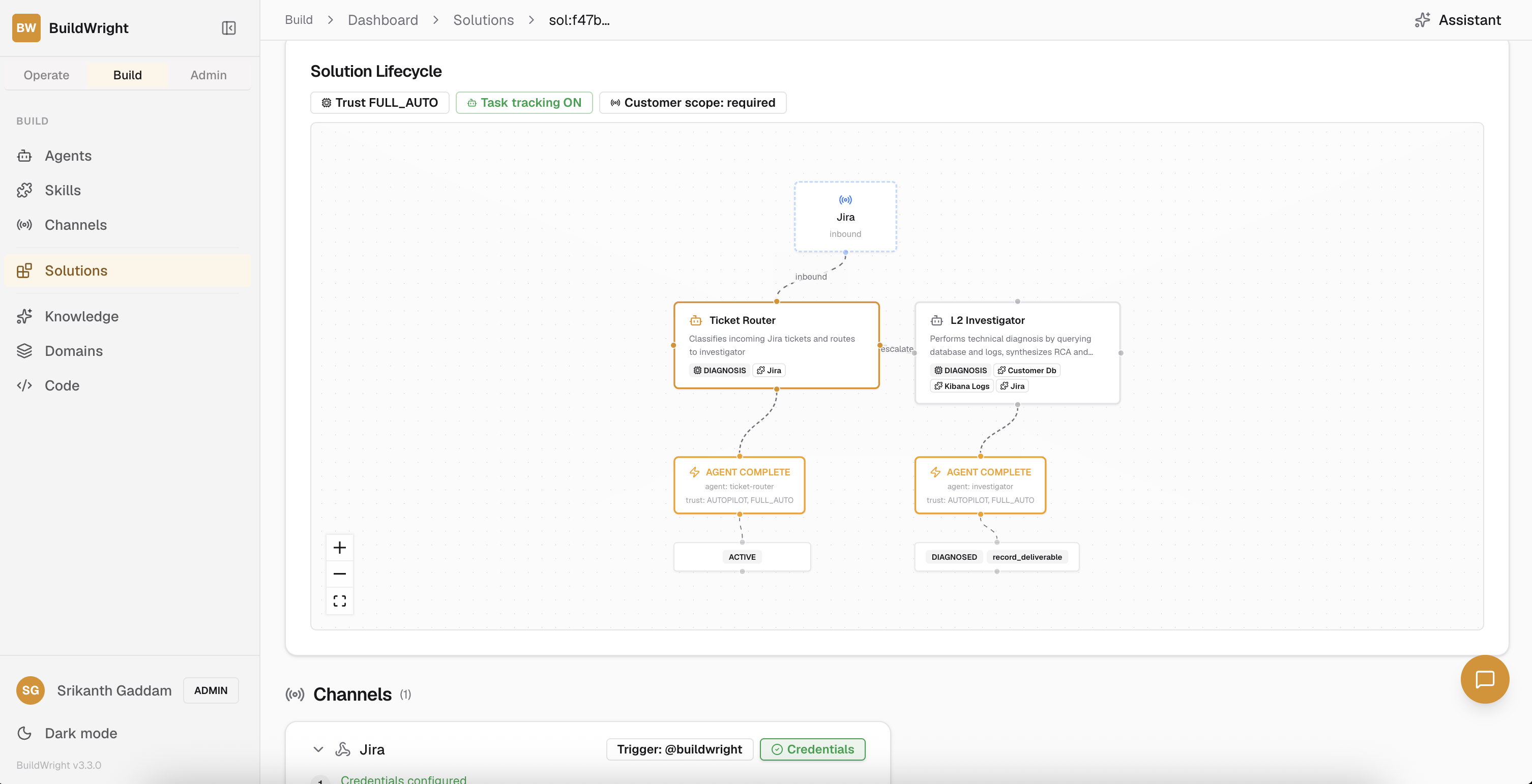
Solution lifecycle — slide 1 of 5
42%
of engineering time goes to maintenance and debugging
Stripe Developer Coefficient
70%
of every ticket is pure investigation
Practitioner and industry reports
1–4 hrs
average time to root cause hypothesis
Industry benchmark, enterprise support orgs
Whether you lead engineering, run support, or own customer success — the investigation bottleneck is your problem.
From ticket to root cause, before an engineer picks it up. No new tools.
No new dashboards. No new processes. The diagnosis appears in the ticketing system your engineers already use.
Ticket arrives.
A support ticket lands in Jira or Linear — from a customer, from monitoring, from anywhere. An automation rule assigns it to BuildWright.
BuildWright investigates.
It traces code paths, correlates logs across your stack, and searches past resolutions for similar patterns — while the ticket is still fresh.
Diagnosis posted.
A structured root cause analysis lands on the ticket — evidence, excerpts, and recommended actions. Investigation is done before an engineer context-switches.
Your engineer fixes.
Your engineer validates the diagnosis and ships the fix. On edge cases, they can loop BuildWright back in with more context — same workflow as a senior teammate.
Ticket arrives.
A support ticket lands in Jira or Linear — from a customer, from monitoring, from anywhere. An automation rule assigns it to BuildWright.
BuildWright investigates.
It traces code paths, correlates logs across your stack, and searches past resolutions for similar patterns — while the ticket is still fresh.
Diagnosis posted.
A structured root cause analysis lands on the ticket — evidence, excerpts, and recommended actions. Investigation is done before an engineer context-switches.
Your engineer fixes.
Your engineer validates the diagnosis and ships the fix. On edge cases, they can loop BuildWright back in with more context — same workflow as a senior teammate.
Proof, not theory
On a real ERPNext bug, BuildWright named the exact file and method the merged fix changed — without ever seeing the answer.
A real diagnosis, scored against the pull request that actually shipped.
You decide how much it does.
Every solution runs at a trust level you set. It moves up only when it is earned — never by default.
Shadow
Investigates and drafts a diagnosis. Nothing posts. You watch it reason before you trust it with anything.
Copilot
Proposes a diagnosis; a human approves before it posts to the ticket. The default for most teams.
Autopilot
Auto-posts its diagnosis for the case types it has proven on, and still flags the ones that need a human. Earned per solution, not switched on blindly.
Per-run trust level is visible on every run and enforced across every approval gate.
It tells you when it is guessing. Most AI does not.
Every diagnosis is graded on its own evidence.
The evidence supports the diagnosis.
Some support — the gaps are named.
Not enough evidence. It says so, and asks for what is missing.
No green checkmark that lies. When the evidence is not there, BuildWright flags it and asks for the missing context instead of inventing a confident wrong answer — the difference between a tool your engineers trust and one they double-check.
Diagnosis only. By design.
Investigation and execution are different trust domains. BuildWright stays on the investigation side.
Diagnosis is automatic. Authority stays human.
In our payments sandbox, BuildWright traced a double-posted wallet debit to a missing idempotency guard in the webhook handler — and refused to move the money. A human approved the reversal. On a Regulation E dispute, it escalated to compliance instead of answering. Every tool call and decision is visible, and gated.
Diagnosis only. Never executes.
BuildWright stays on the investigation side. No database writes, no code deployments, no production modifications — ever.
Encrypted, redacted, audited.
AES-256-GCM credential vault; DLP redaction of SSNs, card numbers, and API keys on inbound and outbound; every tool call logged with a 30-day trace. Tenant data is isolated, never shared.
Read-only, allow-listed egress.
OAuth read-only scopes — no passwords stored. Webhook deliveries are HMAC-signed, and a per-tenant destination allowlist means it can only talk to systems you approve.
Connect four systems and BuildWright is operational.
| Integration | Connect | What BuildWright Does |
|---|---|---|
| Source Code | GitHub, GitLab, Bitbucket | Traces relevant code paths, identifies root cause in your codebase (read-only) |
| Ticketing | Jira, Linear | Receives tickets, posts diagnosis as comments, re-investigates when an engineer asks |
| Observability | Datadog, Sentry, HyperDX | Correlates logs, traces, and events across services during investigation |
| Communication | Slack | Notifies engineers of completed diagnoses, supports conversational follow-ups |


Teams that actually measure it find the same thing: most of a ticket’s resolution time goes to investigation — the searching, tracing, and cross-referencing — not the fix itself.
A 20-year working relationship. Enterprise fintech infrastructure at scale.
Frequently asked questions
Your engineers are investigating. They should be fixing.
No procurement required. Start with one team, one workflow.